
Opinion Today
June 30, 2026
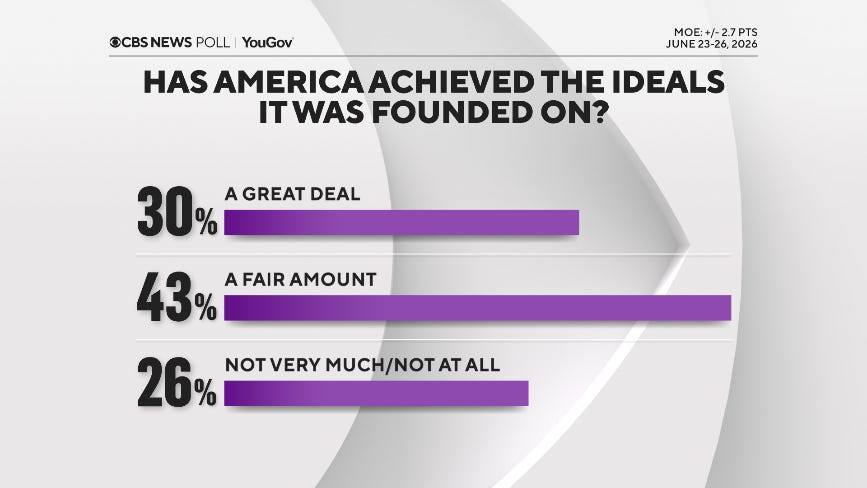
CBS News poll on America at 250 — its successes and its challenges
Fred Backus, Anthony Salvanto and Jennifer De Pinto, CBS News
Two hundred fifty years on, Americans generally see their nation as a success story — even if it's one that they feel still has work to do. A big majority say the nation has succeeded in achieving its founding ideals, at least a fair amount, if not a great deal.
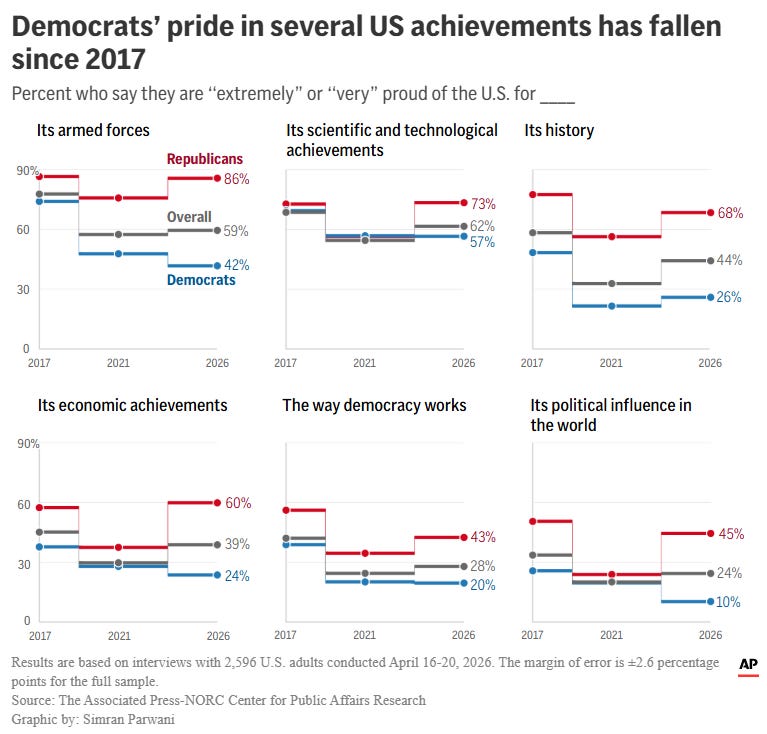
Americans’ pride in US history and democracy drops, and fewer are proud to be American, polls find
Linley Sanders, Simran Parwani and Amelia Thomson-DeVeaux, The Associated Press
Americans have grown less proud of their country’s history or the way its democracy works over the past decade, according to a new AP-NORC poll.
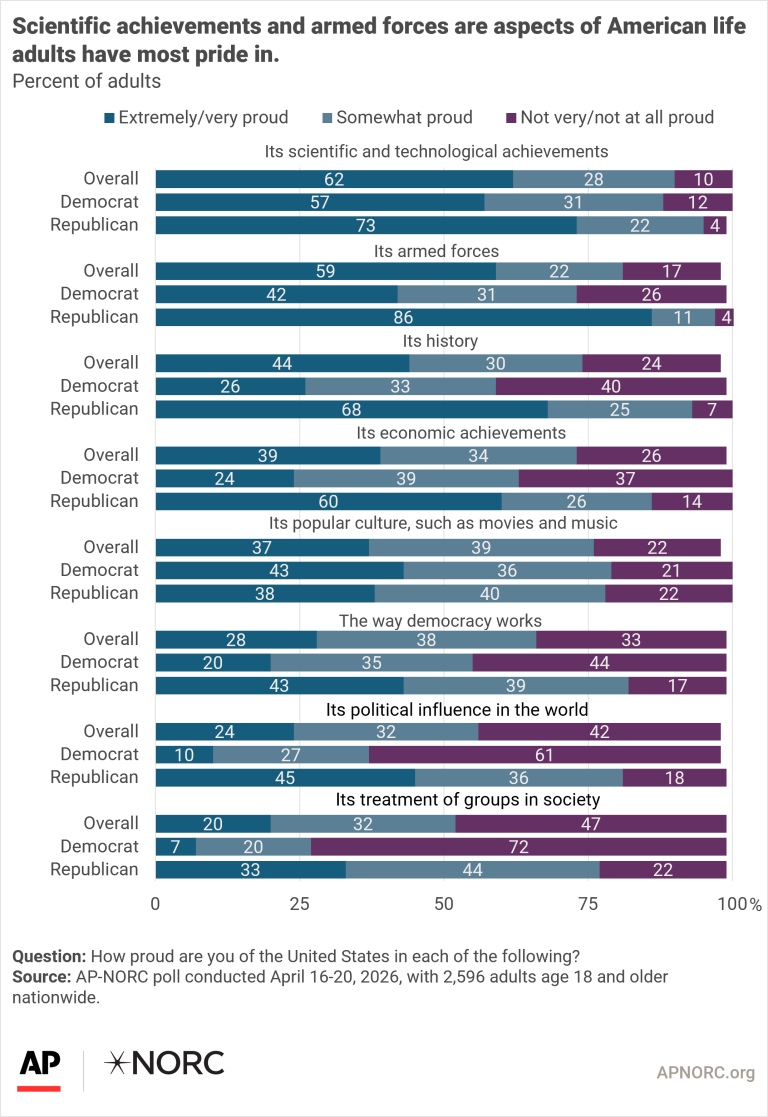
AP-NORC America 250 Poll: Pride and Personal Identity
AP-NORC Center for Public Affairs Research
When it comes to finding pride in the country, its history, and institutions, people are most proud of the military and of scientific and technological achievements. Adults experience varying levels of pride in American institutions. Fewer than half are extremely or very proud of America’s history, economic achievements, popular culture, or the way its democracy works. Only a fifth are especially proud of America’s political influence in the world or the way it treats groups in society.
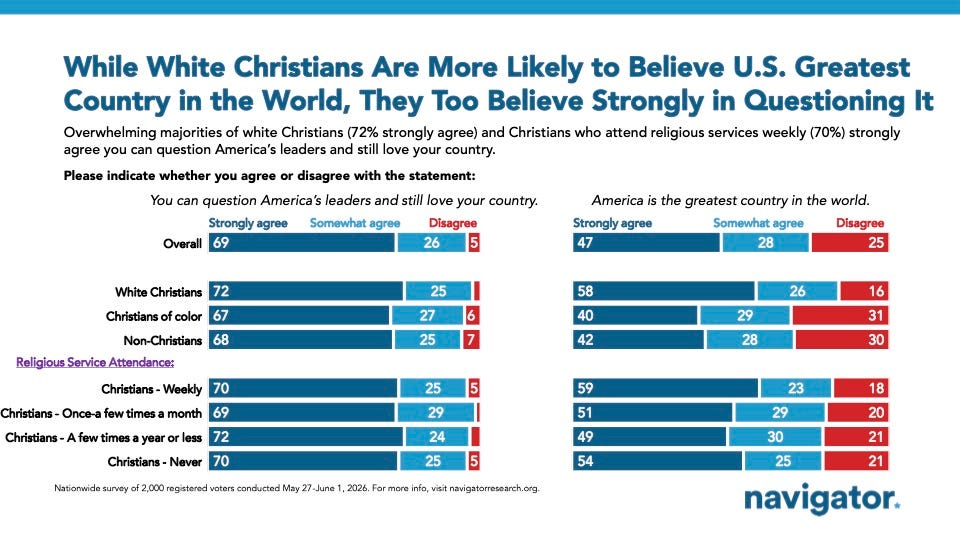
Happy birthday, America? At 250, nation may be too divided to celebrate as one Tim Reid, Joseph Ax and Hannah Beier, Reuters One in five Americans say they won't celebrate Independence Day this year - including a quarter of Democrats and 8% of Republicans - according to a Reuters/Ipsos poll. Two in five do not believe the country will survive another 250 years. To better understand how Americans feel about the anniversary, Reuters interviewed more than two dozen residents, activists, historians and elected officials in Bucks County.... Once a political backwater, Bucks County today is a microcosm of the cultural and partisan schisms convulsing the U.S. How White Christians Feel About America at 250 Julie Alderman Boudreau, Navigator Research This Navigator Research report covers how white Christians feel about what it means to be an American, the rights and freedoms they value most, and how they view the country ahead of its 250th anniversary.
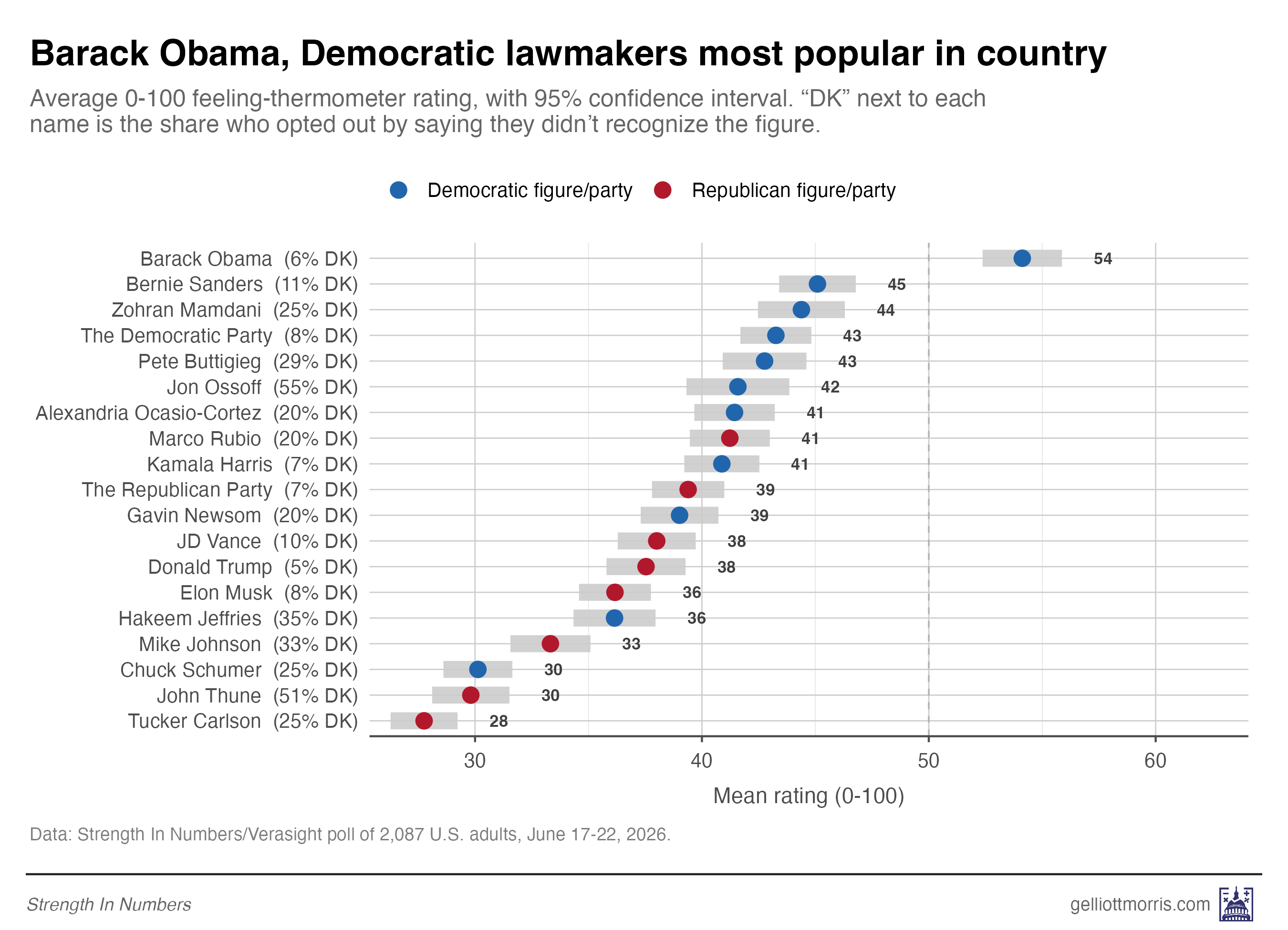
America's most (and least) popular politicians in 2026
G. Elliott Morris, Strength In Numbers
Barack Obama, Bernie Sanders, and Zohran Mamdani top the list, while Tucker Carlson and Chuck Schumer bring up the rear
How Americans view the U.S.-Canada relationship
Alec Tyson, Ipsos
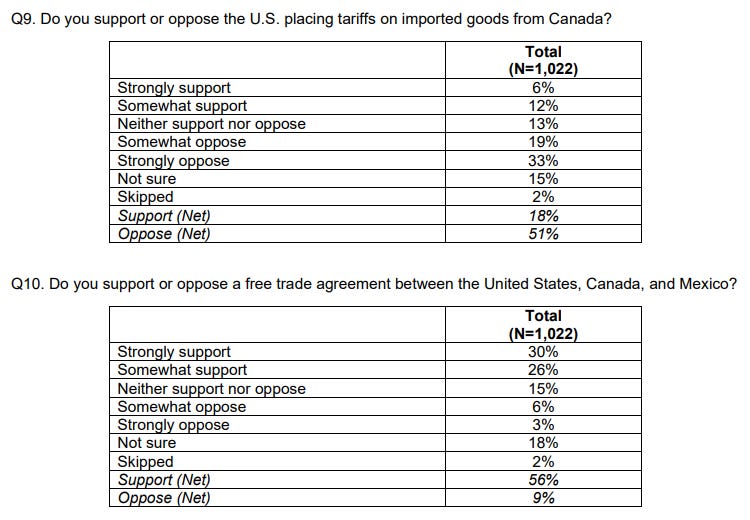
New University of Calgary polling conducted by Ipsos covers Americans’ views of U.S.-Canada relationship, levels of support for U.S. tariffs on Canada, and perceptions of the Canada-U.S.-Mexico trade agreement (USMCA).
Most Americans Back Foreign Aid a Year After USAID’s End
The Rockefeller Foundation
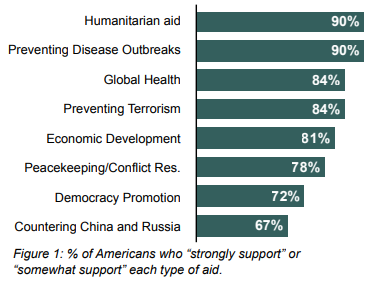
Echelon Insights and The Rockefeller Foundation have released findings from a new public opinion survey evaluating Americans’ opinions on global aid as the nation marks one year since the official closure of the U.S. Agency for International Development (USAID) and looks ahead to America’s 250th birthday.... The survey found that a majority of Americans (54%) have a favorable view of U.S. foreign aid, and despite differing levels of support across the political spectrum, overwhelming majorities support specific types of foreign aid work when described more specifically like humanitarian relief (90%), preventing disease outbreaks (90%), and peacekeeping and conflict resolution (78%).
Americans Still Believe in Strong U.S. Global Leadership and Engagement, Including Young MAGA Republicans
The Ronald Reagan Presidential Foundation and Institute
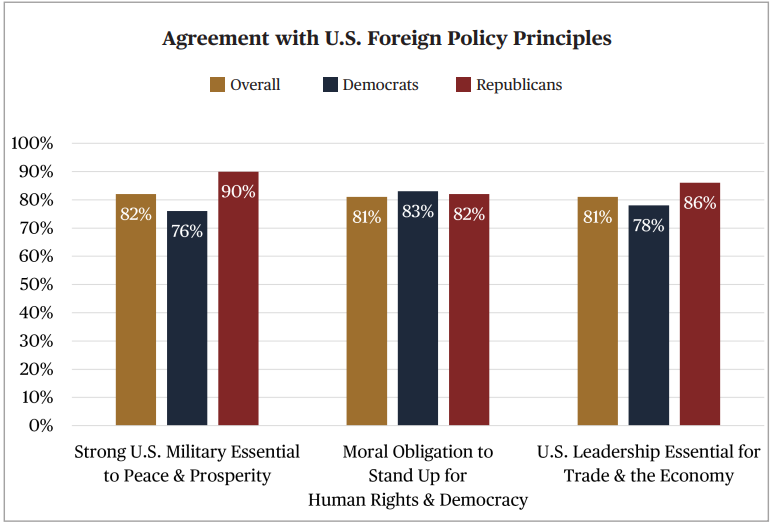
The Ronald Reagan Presidential Foundation and Institute has released results of its annual Reagan Institute Summer Survey, a nationwide public opinion poll on foreign policy and national security issues. Released as the United States prepares to mark its 250th anniversary, the survey finds Americans continue to believe in the core of President Reagan’s foreign policy vision: that American military strength and international engagement remain essential to U.S. security and prosperity.
Which Americans are most likely to have spoken with a local journalist?
Joanne Haner, Pew Research Center
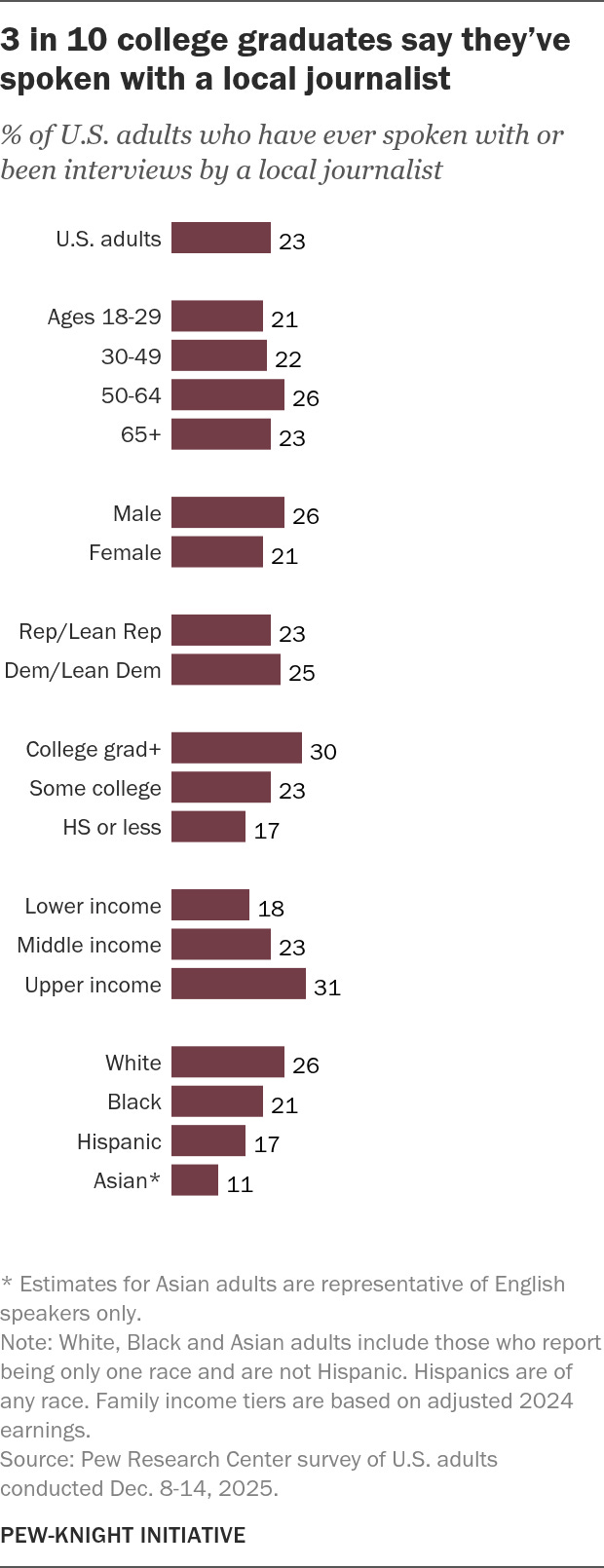
About a quarter of Americans (23%) say they have ever spoken with or been interviewed by a local journalist or reporter, according to a December 2025 Pew Research Center survey from the Pew-Knight Initiative.
Scam Victims Report Billions Lost and Harm to Mental Health
Andrea Malek Ash, Gallup
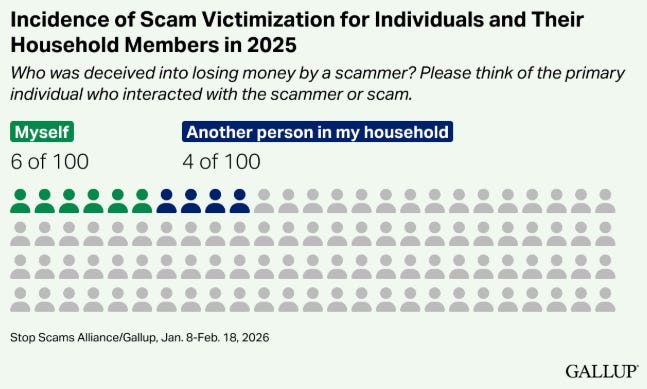
Six percent of U.S. adults (an estimated 15 million people) report being personally scammed in 2025. An additional 4% of adults say that while they themselves were not scammed, another member of their household was. Altogether, 10% of U.S. adults experienced a scam last year, either directly or through someone in their household. These findings are from a new report, United States of Scams: The Financial and Emotional Fallout, by the Stop Scams Alliance and Gallup.
How do Democrats, Republicans feel about AI? New poll sheds light
Fernando Cervantes Jr., USA Today
As artificial intelligence becomes a more visible part of Americans' day-to-day lives, there is bipartisan support for tighter regulation of the technology, according to a new poll. The survey, conducted by the Washington-based AI Policy Institute, found that 68% of respondents said they would support the government creating a "formal review process for the most advanced AI models before they can be widely released."

A Tied Senate Race Gives Democrats a Shot in Deep Red Texas, Poll Finds
Shane Goldmacher, Ruth Igielnik and Camille Baker, The New York Times [unlocked]
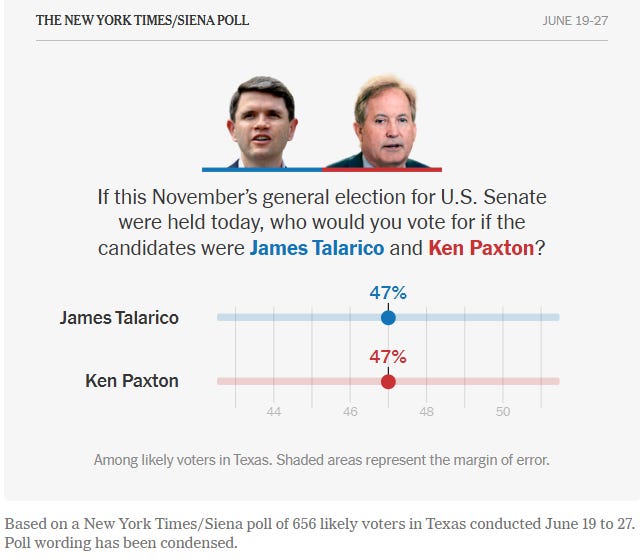
James Talarico, a Democratic state lawmaker, is tied with Ken Paxton, the Republican state attorney general, according to a New York Times/Siena poll.
If you know someone who might be interested, please share this free issue of Opinion Today:
Texas Is a Tossup. The Times/Siena Poll Points to How It Got There.
Nate Cohn, The New York Times [unlocked]
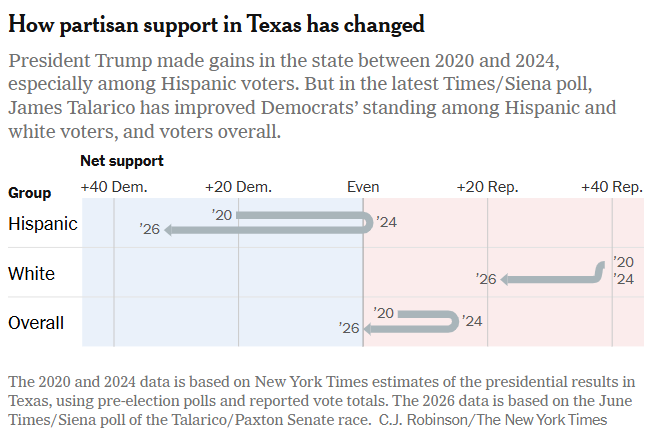
A major shift among Hispanic voters and a favorable candidate matchup have helped put Democrats on the doorstep of a Senate upset.
Connecticut: Most Residents Disapprove of Trump Foreign Policy, See Decision to Start Iran Conflict as Wrong
University of New Hampshire Survey Center
Nearly two-thirds of Connecticut residents disapprove of President Trump's handling of foreign policy and the economy, along with his overall job performance. A similar percentage of Connecticut residents believe the decision to attack Iran was wrong, very few expect the recent memorandum between the U.S. and Iran to produce a full agreement to resolve outstanding issues, and a majority oppose restarting military operations if no deal is reached regarding Iran's nuclear program.

Massachusetts: Most Say Starting Iran Conflict Was Wrong Decision, Approval of Trump Remains Low
University of New Hampshire Survey Center
Seven in ten Massachusetts residents say the U.S. made the wrong decision to attack Iran, in the wake of an announcement of a memorandum of understanding to halt the conflict. President Trump's overall job approval in the state remains low in the state and only a quarter believe the country is on the right track.

New Hampshire: Trump Approval Continues to Erode; Most Believe Iran War Was Wrong Decision
University of New Hampshire Survey Center
Nearly two-thirds of Granite Staters say the decision to go to war with Iran was wrong, few expect a full agreement to materialize during the 60-day negotiating window, and most oppose restarting military operations against Iran if no deal is reached on Iran's nuclear program. President Trump’s job approval rating continues to decline and approval of his handling of foreign policy is at its lowest in either of his terms. Only one-third believe the country is headed in the right direction.

Rhode Island: Trump Job Approval Remains Low Amid Discontent With Iran Conflict
University of New Hampshire Survey Center
Nearly two-thirds of Rhode Islanders disapprove of President Trump's job performance and handling of foreign policy. Only three in ten Rhode Islanders believe it was the right decision for the U.S. to attack Iran and most do not expect the two countries will reach a full peace agreement in sixty days to resolve outstanding issues.

Vermonters Pessimistic About Iran Conflict, Believe Starting It Was Wrong Decision
University of New Hampshire Survey Center
Three-quarters of Vermonters say the decision by the United States to start the conflict with Iran was wrong, only one in ten expect the two countries to reach a full agreement to end the conflict, and most oppose restarting military operations against Iran if no deal is reached on their nuclear program. President Trump's overall job approval in the state remains low, and only a quarter believe the country is on the right track.

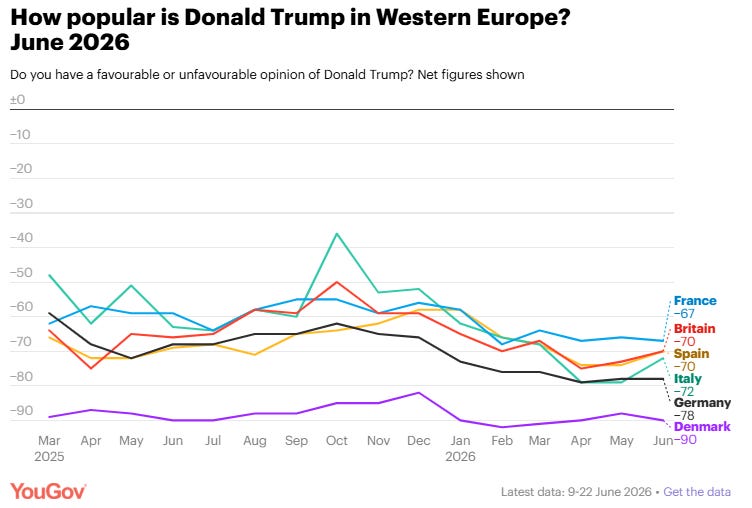
How popular is Donald Trump in Europe?
YouGov
YouGov European tracker series looks at Donald Trump's popularity in Britain, Denmark, France, Germany, Italy and Spain
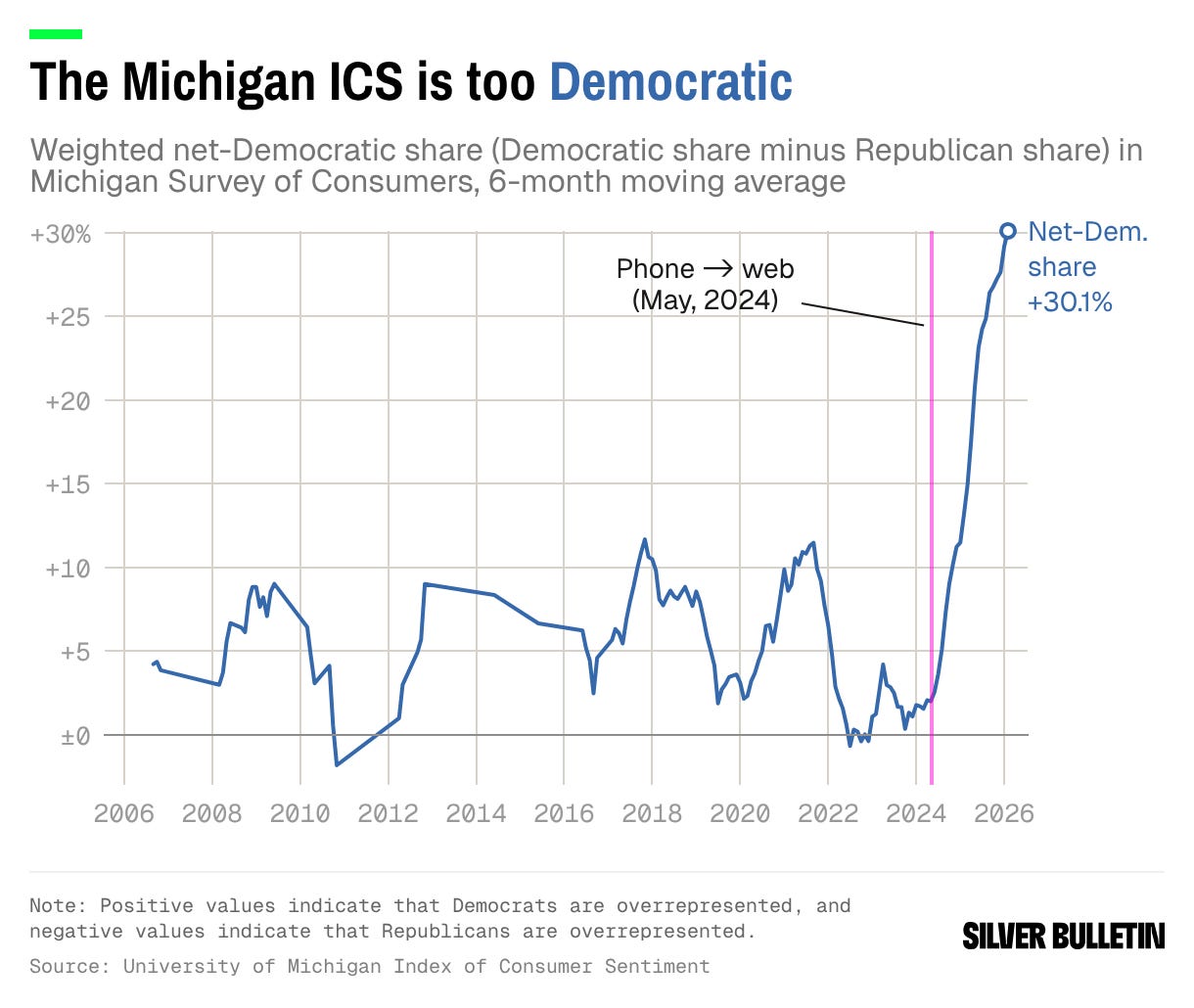
Is the vibecession real — or is the survey broken?
Joel Wertheimer, Silver Bulletin
The University of Michigan Index of Consumer Sentiment is the gold standard sentiment survey measuring consumer sentiment. The survey has historically shown a very strong correlation with “hard” economic data such as inflation and unemployment. But before more bad analysis gets done on the vibecession, people need to know they’re working with dubious data.
The Vibe Has Shifted Back
David Wallace-Wells, The New York Times [unlocked]
We haven’t even hit the midterms yet, and the prospect of an enduring MAGA majority doesn’t look like the natural path of the American future. It looks like a projection from the recent past, already fading.

Can You Really Be a Working-Class Party if There Are Very Few Workers in Your Party?
Thomas B. Edsall, The New York Times [unlocked]
Most of the leadership of the D.S.A. and a majority of voters who back its candidates are in no way working class. Instead, an elite made up of well-educated professionals dominates this insurgency. The D.S.A.’s agenda, in turn, is packed with policies supported by left-wing liberals, white progressives in particular, but strongly opposed by both white and minority working-class (defined, in pollster shorthand, as non-college-educated) voters.

What's Driving the New Urban Left?
Politics by Bill Schneider
Israel or Trump?

Why resisting Trump has galvanized Black Democrats as the midterms approach
Gregory S. Schneider, The Washington Post [unlocked]
High primary turnout among Black voters in the South has given some in the party hope for upset wins in the region.

‘Moderate’ and ‘Electable’ Are Not Synonyms
Michelle Goldberg, The New York Times [unlocked]
The case for Haley Stevens’s candidacy rests on electability, but it’s far from clear how electable she really is.

Inside Republicans’ Plan to Win the Midterms
Alex Roarty, NOTUS
The party has spent years plotting turning out Trump voters. “There has never been an operation like this before,” said the NRCC’s political director.

Trump’s voting restrictions face roadblocks from Congress and the Supreme Court
Jonathan Allen and Katherine Doyle, NBC News
President Donald Trump suffered a number of setbacks from the Supreme Court on Monday, including a decision allowing states to count some ballots that come in after Election Day.

Supreme Court ruling gives a reprieve to states with grace periods for receiving mail ballots
Julie Carr Smyth, The Associated Press
States that allow mail ballots to be counted after Election Day reacted with relief Monday after the U.S. Supreme Court rejected a Republican effort to outlaw the practice.

Supreme Court Mail Ballot Ruling Deals New Blow to Trump’s Election Plans
Emily Davies and Nick Corasaniti, The New York Times [unlocked]
The Supreme Court ruled on Monday that state laws allowing ballots to arrive after Election Day are legal. The decision is the latest in a series of setbacks for President Trump’s efforts to regulate elections.

How A.I. Is Changing the Way Politicians Run for Office
Stuart A. Thompson, The New York Times [unlocked]
A.I.-generated images are the public face of this election overhaul. Behind the scenes, campaigns are using the technology to analyze voter data, craft campaign materials and write custom messages.

UC Berkeley to Open Nancy Pelosi Institute Aimed at Advancing Democracy
Douglas Belkin, The Wall Street Journal [unlocked]
The University of California, Berkeley plans to launch a new institute named for Nancy Pelosi and intended to strengthen democracy. Called the Nancy Pelosi Institute for Representative Democracy, it will be a nonpartisan center for research, teaching and civic engagement, the school said.

Four days to make victims fall in love: How global scammers use US tech to fleece people
Erika Kinetz, The Associated Press
Technology from American companies is being used to power a revolution in the scam industry, playing a key role in the industrialization and globalization of fraud in ways that have not been clear until now, an AP/"FRONTLINE” investigation has found.
If you haven’t already done so, become a paid subscriber and receive the FULL Opinion Today briefing first thing each morning, Monday-Friday, plus an expanded edition on weekends.
PLAYLIST
What Americans think is best about the U.S., according to CBS News polling
CBS News
As we approach 250 years of the nation's founding, new CBS News polling asked Americans about some of the best parts of living in the United States. CBS News' Anthony Salvanto has more.
Democrats aren't happy with Schumer amid a progressivism surge
CNN
CNN chief data analyst Harry Enten breaks down new polling that finds majority discontent with Senate Minority Leader Chuck Schumer, within his own party.
Tamara Keith and Amy Walter on Trump's focus on the SAVE Act
PBS News Hour
NPR’s Tamara Keith and Amy Walter of the Cook Political Report with Amy Walter join Geoff Bennett to discuss the latest political news, including the Supreme Court further expanding the president's authority while rejecting President Trump's effort to restrict mail-in voting, Trump focusing on the SAVE Act and progressive candidates winning Democratic primaries.
Late Ballots, Iran Polling, And A Maine Toss-Up
GD POLITICS
The Supreme Court weighs in on mail ballots, Trump’s Iran deal meets public opinion and Maine’s Senate race looks like a toss-up.